The esophagus has its own community of microbes, and these microbes play a meaningful role in esophageal health and disease. But the field of gastroenterology remains overwhelmingly focused on the mid and lower sections of the body, leaving the potential of esophageal microbiota unknown to many gastroenterologists.
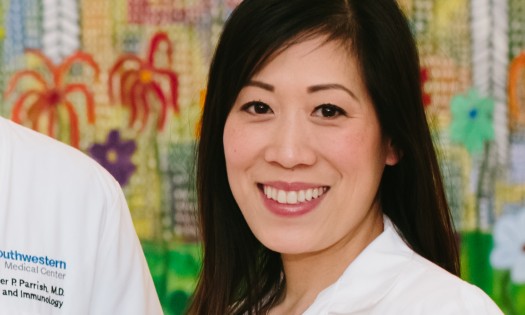
Nonyelum Ebigbo, M.D., Pediatric Gastroenterologist at Children’s HealthSM and Assistant Professor at UT Southwestern, is leading research highlighting the unique bacteria that accompany esophageal disease and the ways these microbes affect the immune system and development of inflammation.
This research could lead to new biomarkers, treatments and approaches to conditions like eosinophilic esophagitis (EoE) that are often resistant to existing therapies.
“Understanding the interplay between microbes, esophageal cells and the immune system will open the door to earlier diagnosis, better prevention and new treatments,” Dr. Ebigbo says.
Details of esophageal bacteria and cells point to an active immune environment
Dr. Ebigbo’s work, which is supported by a KL2 grant from the National Institutes of Health through the UT Southwestern CTSA, includes a recent overview of the subject in the American Journal of Physiology. In the paper, she describes two main clues that esophageal microbiota is actively involved in disease and inflammation.
1. The first is that people who have esophageal disorders often have a different mix and amount of bacteria in their esophagus compared with people who don’t. In some cases, this microbial community appears to be out of balance, a state known as dysbiosis. For example, some studies have found higher levels of Haemophilus in patients with EoE than in those without EoE. “There is even a measurable difference in levels between active disease and inactive disease,” says Dr. Ebigbo.
2. The second clue is that cells in the esophageal lining mirror those in the colon. “Cells in the esophageal epithelium express toll-like receptors and other pattern recognition receptors that interact with bacteria in the esophagus. We assume these cells play a similar immunological function as they do in the colon,” Dr. Ebigbo says.
How bacteria may contribute to inflammation in the esophagus
Based on activity in the colon, researchers propose the inflammatory cascade in the esophagus happens like this:
Bacteria attach to the lining of the esophagus.
Pattern recognition receptors on the lining detect flagella, lipopolysaccharide or other pathogen-associated molecular patterns on the bacterial membrane.
The receptors use these patterns to identify harmful bacteria, and the cell reacts to heal itself.
The healing process loosens the tight junctions that hold cells together, enabling acid or bile to enter and cause inflammation.
While that cascade seems likely, further research is necessary to prove it.
“It’s clear the esophagus is not the sterile tube we once thought it was. But we’re just scratching the surface of what the interactions and implications are,” Dr. Ebigbo says.
Next up: Preclinical models and sample methods
The next step is to study these bacteria associated with esophageal disease in preclinical models, such as cell cultures and mouse models, to determine whether they actively contribute to disease. Dr. Ebigbo plans to lead such a project soon, as part of her KL2 grant.
She is also considering a study that compares different methods of collecting microbial samples from the esophagus. The current gold standard is to biopsy the tissue endoscopically, but this method requires sedation.
“Finding a less intensive method would accelerate research significantly,” says Dr. Ebigbo.
The esophageal string test (EST) and Cytosponge are non-invasive methods that can be used to study the esophageal microbiome. Both involve swallowing unobtrusive materials – a string in one case, a sponge in the other – then removing them and analyzing what they collected inside the esophagus. EST is currently used to monitor EoE in children, and the Cytosponge helps diagnose Barrett’s esophagus and esophageal cancer in adults.
“For sampling microbes, it’s possible these methods can only sample the luminal microbiota that floats freely, and not the mucosal microbiota attached to the lining,” Dr. Ebigbo explains.
A study directly comparing these methods with endoscopic sampling would help determine which method provides the highest quality specimens, including sufficient microbial yield, and clarify their role as potential alternatives or complements to endoscopic collection.
Understanding microbial impact can unlock new treatments
Understanding the microbiota of the esophagus may one day help gastroenterologists detect and treat esophageal disorders in more proactive and individualized ways.
EoE is a perfect illustration. Patients have different clinical, endoscopic and pathologic endotypes, and they respond to treatments in different ways. It’s common for children to cycle through elimination diets, proton pump inhibitors and oral steroids without achieving adequate relief. Since 2022, the monoclonal antibody dupilumab has been available, with promising results. Cracking the microbial contribution to disease could open the door to even more treatment options.
“We may find proteins that serve as biomarkers to help us predict and prevent disease as well as guide more effective treatments. Or we may find metabolites that can be used to help fight disease,” Dr. Ebigbo explains.
That future may look distant now, but this area of study is so open that it’s ripe for innovation.
“Once we begin answering the questions we’re asking today, other questions and implications will quickly follow. I hope this becomes an active and fruitful area of inquiry quite soon,” says Dr. Ebigbo.
Learn more about GI and the Eosinophilic Disorders Program at Children’s Health.